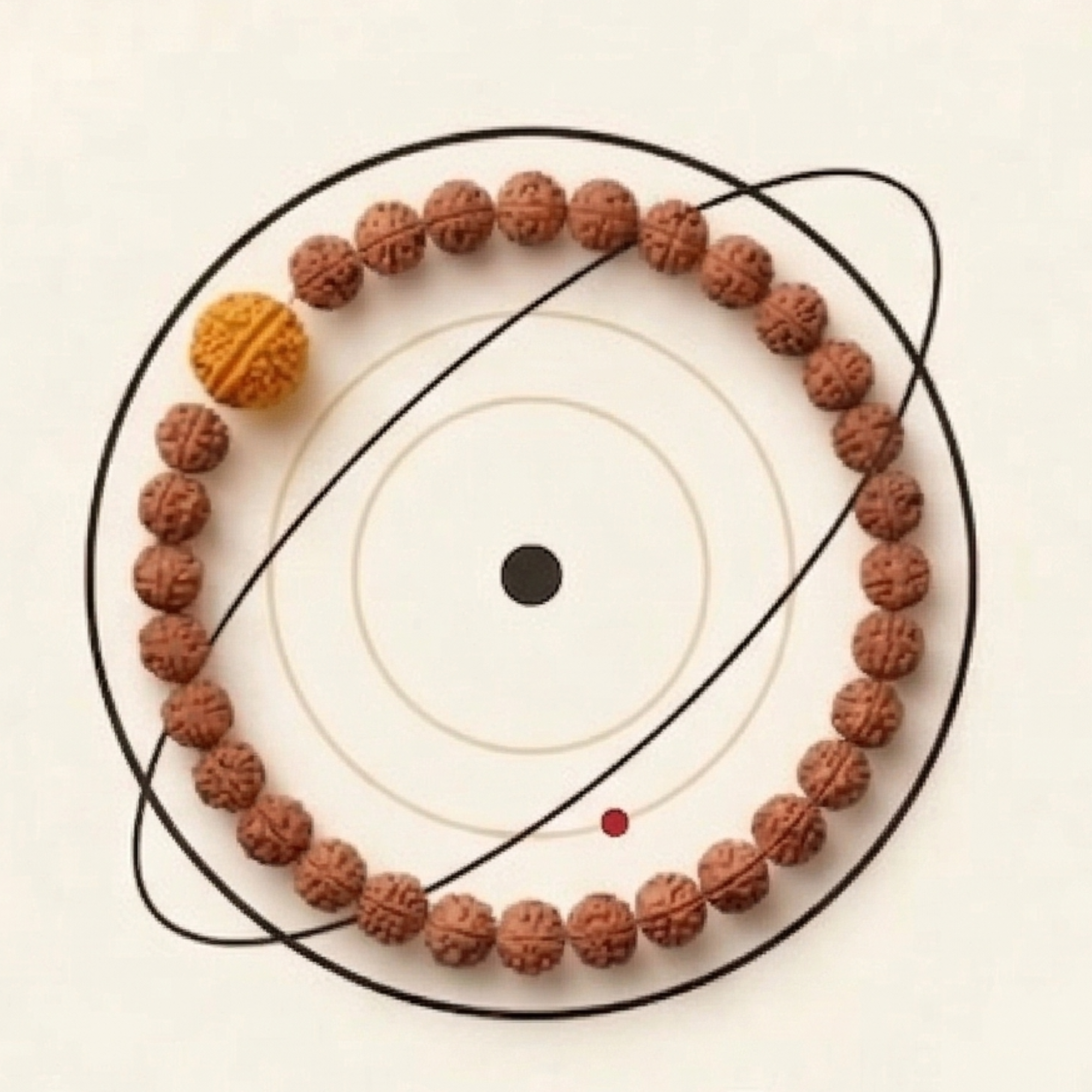

Vedic astrology — known in Sanskrit as Jyotish, "the science of light" — is the world's oldest continuous astrological tradition. At its heart is a simple, powerful idea: your Kundli (birth chart) reveals which planetary forces are strong, weak, or troubled in your life — and a specific mantra can help you balance them. This guide explains the Kundli → mantra connection in plain language, no Sanskrit prerequisite needed.
Count your 108 right here
Tap once per repetition. Nothing to install.
Your mantra
0
0 / 108
Malas: 0 · Total japs: 0
Picked up where you left off.
Your sankalp
Sankalp complete 🙏
At this pace:
1 mala complete 🙏
Make this a sankalp
Set a lifetime target and keep chanting toward it.
Keep your jap history, streaks, and sankalpa targets in AstroJap.
Save your streak → install AstroJapWhat is Vedic Astrology?
Vedic astrology (Jyotish) is the system of reading celestial influence on human life based on the sidereal zodiac — the actual position of stars at the moment of your birth. It is one of the six vedangas (limbs of the Vedas) and has been practised continuously for over 5,000 years.
Two things distinguish Jyotish from popular Western astrology:
- The Navagraha — nine planetary forces, including the lunar nodes Rahu and Ketu.
- Remedies — Jyotish doesn't just describe; it prescribes practical solutions, especially mantra jap, gemstones, and yantras.
Your Kundli, Explained Simply
A Kundli (also called birth chart, janma kundali, or rashi chakra) is a snapshot of the sky at the exact moment of your birth — drawn as a 12-house diagram. Each house represents an area of life:
- 1st house — Self, body, personality
- 2nd — Wealth, family, speech
- 4th — Mother, home, emotional foundation
- 7th — Marriage, partnerships
- 10th — Career, dharma, public role
- (... and so on through the 12 houses)
Where each of the nine grahas sits at your birth — and which house, sign, and nakshatra they occupy — paints your unique chart.
The Navagraha — 9 Planetary Forces
- Surya (Sun) — Soul, ego, father, vitality
- Chandra (Moon) — Mind, mother, emotion
- Mangal (Mars) — Energy, courage, conflict
- Budh (Mercury) — Intellect, communication, commerce
- Guru (Jupiter) — Wisdom, expansion, dharma
- Shukra (Venus) — Love, beauty, creativity
- Shani (Saturn) — Discipline, karma, lessons
- Rahu — Obsession, ambition, illusion (north node)
- Ketu — Detachment, moksha, past karma (south node)
For each, there is a corresponding mantra — see the full table in our Navagraha mantras guide and the seed-syllable form in Beej mantras for all 9 planets.
Why Vedic Astrology Prescribes Mantras
Jyotish treats each graha as a vibrational frequency. When a graha is afflicted in your Kundli — debilitated, combust, or under aspect from a malefic — its frequency in your subtle body becomes "noisy." Mantra jap is the most accessible way to retune that frequency:
- Daily repetition synchronises your nervous system with the graha's mantra vibration.
- The 108 count is itself an astrological number — 12 zodiac signs × 9 planets = 108.
- Modern research on mantra meditation (see our research roundup) supports stress reduction and improved focus.
How a Kundli Decides Your Mantra
A typical Jyotish-driven mantra recommendation looks at:
- Lagna (ascendant) lord — strengthen the lord of your 1st house.
- Mahadasha — the graha currently ruling your 16-year planetary period (the most important factor).
- Antardasha — the sub-period within the mahadasha.
- Specific doshas — Sade Sati (Saturn 7.5-year period), Mangal Dosh, Kaal Sarp Dosh, Pitru Dosh.
- Transits — current sky positions affecting your chart.
Doing this by hand requires years of Jyotish study. AstroJap automates the analysis: enter your birth details, and the app computes your lagna, mahadasha, doshas and current transits — then prescribes the right mantra and tracks your daily jap on a 108-bead digital jap counter.
Your Next Step
If this is your first introduction to Vedic astrology, here's a sensible path forward:
- Read about graha doshas to understand which afflictions are common.
- Pick a weekday-aligned mantra as your first daily practice.
- Get a personalized Kundli mantra and track your jap on the AstroJap app.
- Follow the 7-day mantra practice plan to build the habit.
Frequently Asked Questions
What is the difference between Vedic astrology and Western astrology?
Vedic astrology (Jyotish) uses the sidereal zodiac based on actual star positions and includes 9 planetary bodies (Navagraha) including the lunar nodes Rahu and Ketu. Western astrology uses the tropical zodiac based on the Sun's relationship with seasons. Vedic astrology also focuses heavily on remedies — particularly mantra remedies — which Western astrology generally does not.
Do I need to be Hindu to follow Vedic astrology?
No. Jyotish is a science of cosmic time and personality, not a religion. Anyone, regardless of faith, can have their Kundli analyzed and benefit from understanding their planetary inclinations and remedies.
How does a mantra actually 'fix' a planetary problem?
Vedic tradition holds that each graha has a specific vibrational signature. Chanting the corresponding mantra — daily, with focus, in correct count — gradually attunes your subtle body to that frequency, balancing the graha's effect. Modern interpretations also point to the psychological discipline and focus that daily jap creates.
What is a Kundli in Vedic astrology?
A Kundli (birth chart) is a 2D map of the sky at the exact moment and place of your birth. It plots the position of the 9 planets (Navagraha) across 12 houses (bhavas) and 12 signs (rashis). Each placement reveals strengths, challenges, and karmic patterns. Vedic jyotish uses the Kundli as the primary tool for life analysis and remedy prescription.
What are the 9 planets in Vedic astrology?
The Navagraha are: Surya (Sun), Chandra (Moon), Mangal (Mars), Budh (Mercury), Guru (Jupiter), Shukra (Venus), Shani (Saturn), Rahu (North Node), and Ketu (South Node). Rahu and Ketu are not physical planets but lunar nodes — they are unique to Vedic astrology and absent from Western systems.
How is my mantra chosen from my Kundli?
A jyotishi looks at which planets are weak, debilitated, or causing dosha in your chart. The weakest or most malefic graha gets the primary mantra prescription. For example: weak Sun → Surya beej mantra or Gayatri; afflicted Mars → Mangal beej or Hanuman Chalisa; Shani in Sade Sati → Shani mantra. AstroJap automates this analysis.